
Quick Answer
How does hearing work?
Hearing works through a remarkable chain of events: sound waves enter your ear canal and vibrate your eardrum. These vibrations pass through three tiny bones to the cochlea, a fluid-filled structure in your inner ear. Hair cells in the cochlea convert the vibrations into electrical signals that travel via the auditory nerve to your brain, where they're interpreted as sound.
Your ears are constantly working — processing everything from whispered conversations to thundering music, from a pin drop to a jet engine. But how exactly does this complex system turn invisible waves in the air into the rich world of sound you experience?
In this guide, we'll explore the fascinating science of hearing, from the anatomy of your ear to how your brain processes sound.
The Anatomy of Your Ear
Your ear is divided into three main sections, each playing a crucial role in hearing:
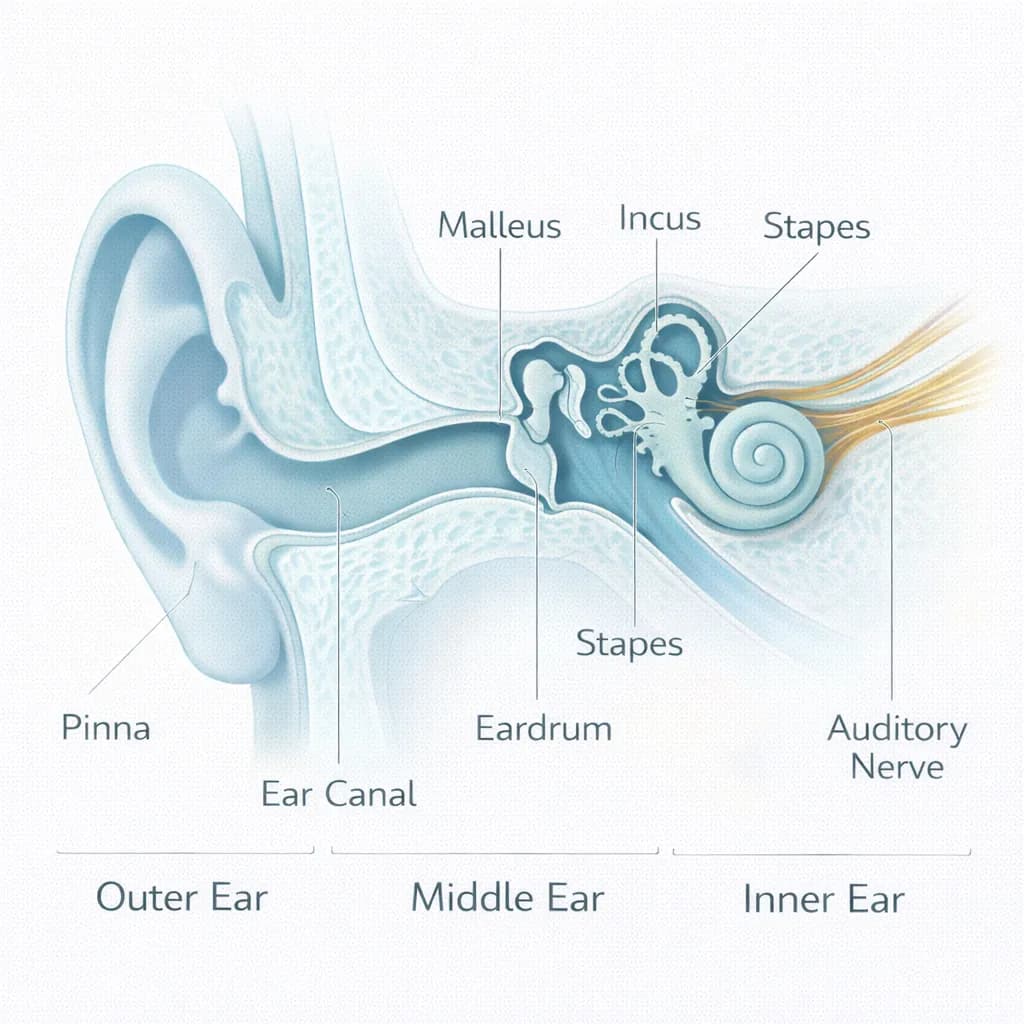
The three sections of the human ear: outer, middle, and inner ear
The Outer Ear
The outer ear is the visible part and includes:
Pinna (Auricle) The curved, fleshy part you see on the side of your head. Its unique shape isn't just for aesthetics — those folds and curves help capture sound waves and funnel them into your ear canal. The pinna also helps you determine where sounds are coming from.
Ear Canal (External Auditory Meatus) A tube about 2.5 centimeters long that leads to your eardrum. It's lined with tiny hairs and glands that produce earwax (cerumen), which protects your ear from dust, debris, and bacteria.
The Middle Ear
Behind your eardrum lies the middle ear, an air-filled cavity containing:
Eardrum (Tympanic Membrane) A thin, cone-shaped membrane that vibrates when sound waves hit it. Despite being only about 0.1 millimeters thick, it's remarkably durable and can vibrate thousands of times per second.
Ossicles: The Three Smallest Bones in Your Body
- Malleus (Hammer): Attached to the eardrum, it receives vibrations first
- Incus (Anvil): The middle bone that transfers vibrations
- Stapes (Stirrup): The smallest bone in the human body, connecting to the inner ear
These three bones amplify sound vibrations by about 20 times before passing them to the inner ear. This amplification is necessary because sound travels differently through air than through the fluid in your inner ear.
Eustachian Tube A narrow passage connecting your middle ear to the back of your throat. It equalizes air pressure on both sides of your eardrum — that's why swallowing or yawning helps your ears "pop" during altitude changes.
The Inner Ear
The inner ear contains the most complex structures:
Cochlea A snail-shaped, fluid-filled structure about the size of a pea. Inside are thousands of microscopic hair cells — the true sensory receptors of hearing. When fluid waves move through the cochlea, these hair cells bend and generate electrical signals.
Hair Cells You're born with approximately 16,000 hair cells in each ear. Unlike many cells in your body, hair cells don't regenerate. Once damaged, hearing loss in that frequency range is permanent.
Auditory Nerve A bundle of nerve fibers that carries electrical signals from the cochlea to your brain. It contains about 30,000 nerve fibers, each tuned to different frequencies.
Vestibular System While not directly involved in hearing, the inner ear also contains your balance organs — the semicircular canals and otolith organs. This is why inner ear problems can affect both hearing and balance.
The Journey of Sound: Step by Step
Here's how a sound wave becomes something you hear:
Step 1: Sound Wave Collection
Sound waves — vibrations traveling through the air — are captured by your pinna and funneled into your ear canal.
Step 2: Eardrum Vibration
The sound waves travel down the ear canal and strike your eardrum, causing it to vibrate. Higher-pitched sounds create faster vibrations; louder sounds create larger vibrations.
Step 3: Ossicle Amplification
The vibrating eardrum moves the malleus, which moves the incus, which moves the stapes. This chain of bones amplifies the vibrations and transfers them to the oval window — a membrane-covered opening to the inner ear.
Step 4: Fluid Wave Creation
The stapes pushes against the oval window, creating pressure waves in the fluid inside the cochlea.
Step 5: Hair Cell Activation
As fluid waves travel through the cochlea, they cause the basilar membrane to ripple. Hair cells sitting on this membrane bend in response, opening ion channels that create electrical signals.
Different parts of the cochlea respond to different frequencies:
- The base (near the oval window) responds to high-frequency sounds
- The apex (the center of the spiral) responds to low-frequency sounds
Step 6: Neural Transmission
The electrical signals travel along the auditory nerve to the brainstem, then to the auditory cortex in your brain.
Step 7: Brain Processing
Your brain interprets the electrical signals, identifying the sound, its location, its meaning, and its emotional content. This happens almost instantaneously — the entire process from sound wave to perception takes only about 0.05 seconds.
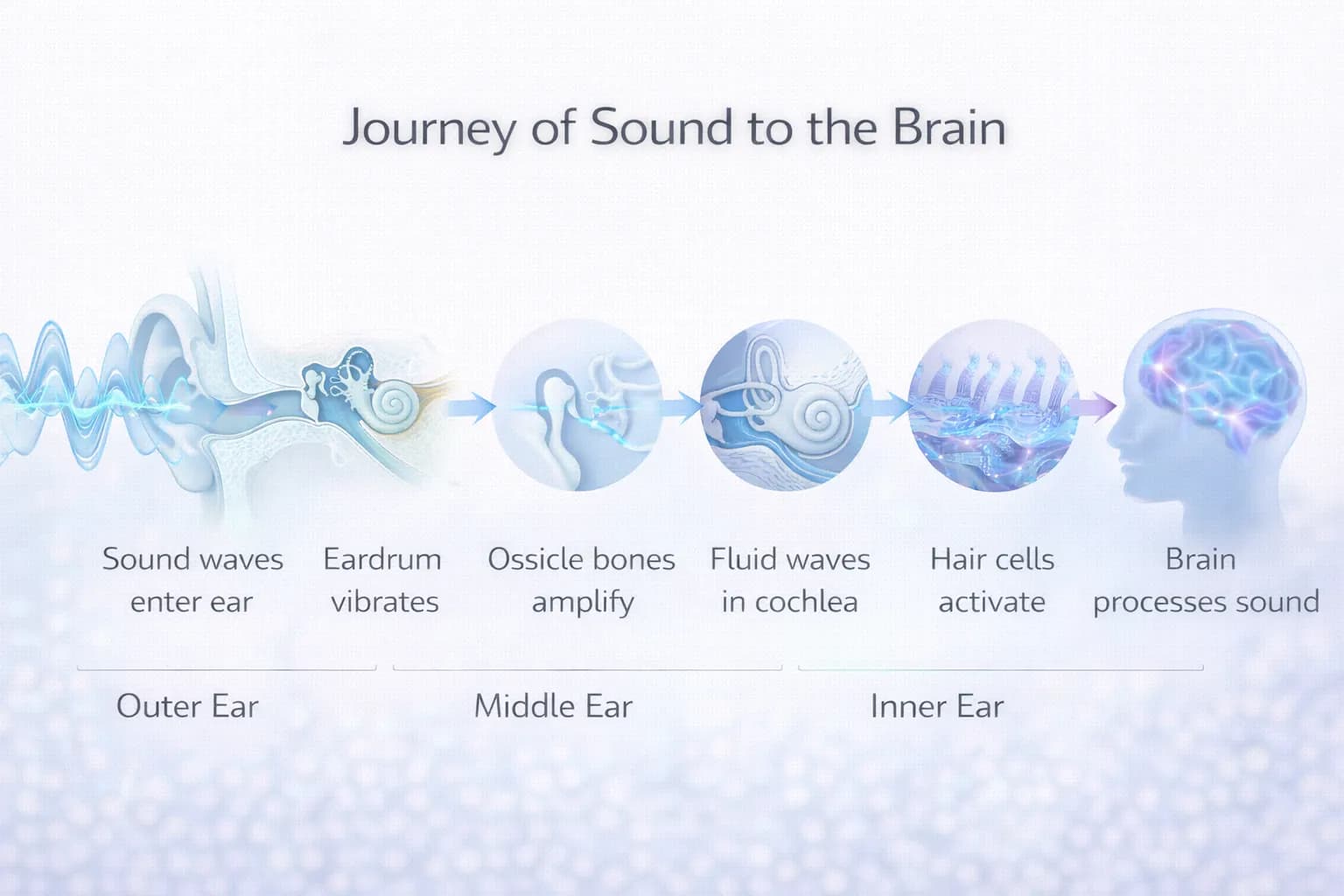
How sound waves become the sounds you hear — in just 0.05 seconds
How Your Brain Processes Sound
Hearing doesn't end at your ears. Your brain does remarkable work to make sense of auditory information:
Sound Localization
Your brain compares the timing and intensity of sounds reaching each ear to determine where sounds are coming from. A sound from your right reaches your right ear slightly before your left ear — your brain detects this difference, even when it's just microseconds.
Pattern Recognition
Your auditory cortex identifies patterns in sounds, allowing you to recognize speech, music, and familiar voices. This is why you can pick out a friend's voice in a crowded room.
Filtering
Your brain constantly filters out unimportant sounds. Right now, you're probably not noticing the hum of your computer or the ambient noise around you — until you read this sentence. That's your brain's selective attention at work.
Memory Integration
Sound is processed alongside memory, which is why certain songs can instantly transport you back to specific moments in your life.
What Can Affect Hearing?
Many factors influence how well your hearing works:
Age-Related Changes
Hearing naturally changes with age. By age 65, about one-third of people have some degree of hearing loss. This typically affects high frequencies first, making it harder to hear consonants in speech.
Noise Exposure
Loud sounds can damage hair cells. Brief exposure to very loud sounds (like explosions) can cause immediate damage, while prolonged exposure to moderately loud sounds (like factory noise or loud music) causes gradual damage over time.
Sound levels to be aware of:
- Normal conversation: 60-70 decibels (safe)
- City traffic: 80-85 decibels (safe for limited time)
- Concerts/headphones at max: 100-110 decibels (damage can occur in minutes)
- Firearms/jet engines: 140+ decibels (immediate damage possible)
Earwax Buildup
While earwax protects your ears, excessive buildup can block sound waves from reaching your eardrum, causing temporary hearing reduction.
Infections
Middle ear infections (otitis media) can cause fluid buildup that interferes with ossicle movement. Inner ear infections can damage hair cells.
Circulation
Your inner ear requires good blood flow to function properly. Conditions that affect circulation can impact hearing health.
Medications
Certain medications (called ototoxic drugs) can damage hearing. These include some antibiotics, cancer treatments, and high doses of aspirin.
Genetics
Some hearing conditions are inherited. Genetic factors can affect how susceptible you are to noise damage and age-related hearing loss.
Protecting Your Hearing
Since hair cells don't regenerate, protecting your hearing is essential:
Limit Noise Exposure Follow the 60/60 rule for headphones: no more than 60% volume for no more than 60 minutes at a time. Wear ear protection at concerts and when using loud equipment.
Give Your Ears Rest After exposure to loud sounds, give your ears time to recover in quiet environments.
Keep Ears Dry Excess moisture can promote bacterial growth. Dry your ears thoroughly after swimming or showering.
Don't Insert Objects Never put cotton swabs or other objects into your ear canal. They can push wax deeper or damage your eardrum.
Get Regular Checkups Annual hearing tests become important as you age, especially after 50.
Support Overall Health Good cardiovascular health supports ear health. Exercise, a healthy diet, and not smoking all benefit your hearing.
For those already experiencing hearing changes like tinnitus (ringing in the ears), understanding how your auditory system works can help you explore supportive options. Learn more in our guide on natural approaches to tinnitus.
Fascinating Hearing Facts
- Your ears never stop working, even while you sleep. Your brain just filters out most sounds.
- The smallest bones in your body (the ossicles) are fully formed at birth and don't grow larger.
- Humans can distinguish between hundreds of thousands of different sounds.
- Your right ear is better at processing speech, while your left ear is better at processing music and emotional content.
- Sound travels about 4 times faster through water than through air.
- The loudest sound your ear can handle without damage is about 1 trillion times more intense than the quietest sound you can hear.
Key Takeaways
- Hearing involves three ear sections working together: outer, middle, and inner ear
- Hair cells in the cochlea convert sound vibrations into electrical signals
- Your brain does significant processing to interpret what you hear
- Hair cells don't regenerate — once damaged, hearing loss is permanent
- Protecting your hearing through noise management is essential
- Many factors affect hearing: age, noise exposure, circulation, medications, and genetics
Medical Disclaimer
This article is for informational purposes only and does not constitute medical advice. The content is not intended to diagnose, treat, cure, or prevent any disease. Always consult with a qualified healthcare provider before starting any supplement regimen, especially if you have existing health conditions or take medications.